
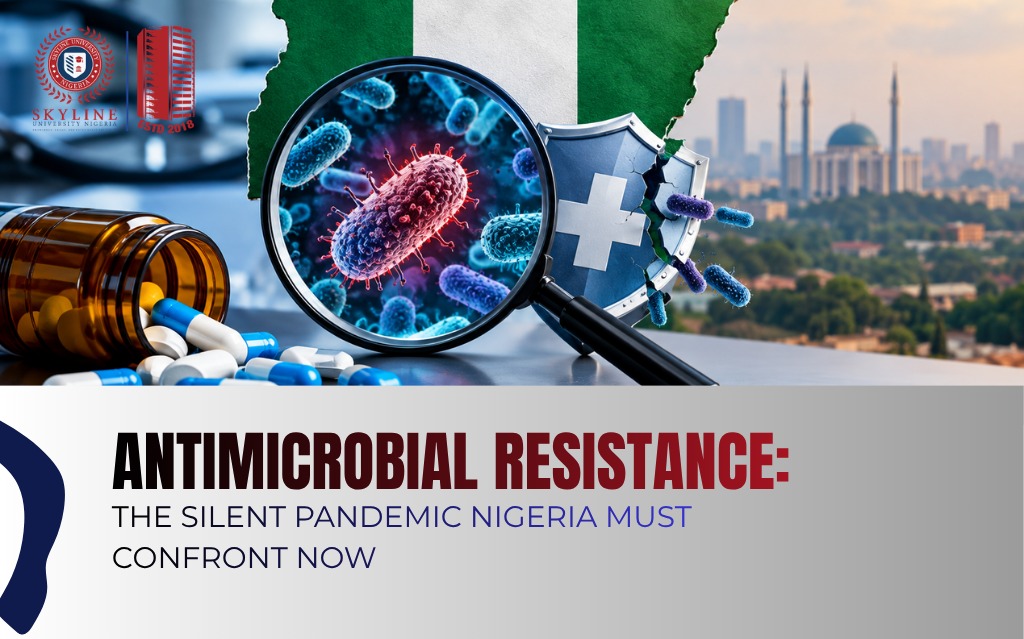
What happens when the medicine we trust to save a life stops working?
A child develops pneumonia. A mother develops an infection after caesarean surgery. A patient arrives at the hospital with severe sepsis. The antibiotic that should have brought relief is administered, but the infection continues to worsen, another drug is tried and it fails too.
This is not a scene from a distant future. It is the growing reality of antimicrobial resistance (AMR).
Unlike COVID-19, AMR does not arrive with dramatic headlines, crowded isolation centers or daily statistics. It advances quietly in hospitals, communities, farms and the environment. Yet its consequences can be devastating. Resistant infections can turn ordinary illnesses into prolonged battles, increase hospital stays and healthcare costs, and ultimately claim lives.
For Nigeria, the warning bells are already ringing.
Antimicrobials have transformed modern medicine, but their effectiveness is being threatened by misuse and overuse. Unnecessary prescriptions, self-medication, inappropriate drug choices, incomplete treatment and the use of antibiotics when they are not needed all give micro-organisms opportunities to survive and develop resistance.
And when antibiotics fail, the consequences extend far beyond the individual patient.
Modern healthcare itself depends on effective antimicrobials. Caesarean sections, major surgeries, cancer chemotherapy, organ transplantation and the treatment of severe infections all become considerably more dangerous when common antibiotics can no longer be relied upon.
The Medical Laboratory: Nigeria’s Critical Weapon Against AMR
In this battle, one weapon deserves far greater attention: Medical laboratory diagnosis.
Too often, infections are treated empirically without confirming their cause. But fever does not automatically mean a bacterial infection, and even when bacteria are responsible, the same antibiotic will not work against every organism.
This is where the medical laboratory becomes indispensable.
Through proper specimen collection, microscopy, culture, identification of microorganisms and antimicrobial susceptibility testing (AST), the medical laboratory provides the evidence needed to determine what is causing an infection and which antimicrobial is most likely to work.
In simple terms, The Medical laboratory replaces guesswork with evidence.
A medical laboratory result can prevent an unnecessary antibiotic from being prescribed. It can identify a resistant organism before it spreads. It can help a clinician move from a broad-spectrum antibiotic to a more targeted treatment. It can also provide the surveillance data needed to understand which resistant organisms are emerging and which antibiotics are losing their effectiveness.
The medical laboratory scientist is therefore not merely a professional who analyses specimens. The Medical laboratory is part of the frontline defence against AMR.
Unfortunately, diagnostic capacity remains inadequate in many settings. Some healthcare facilities lack functional microbiology laboratories, quality-assured reagents, appropriate equipment, trained personnel and reliable systems for transporting specimens. Where diagnosis is unavailable, empirical treatment becomes the default and antimicrobial resistance finds fertile ground.
Nigeria must therefore place medical laboratory diagnosis at the heart of its AMR response. Investment in microbiology laboratories, medical laboratory scientists, quality assurance, diagnostic technologies, specimen referral systems and antimicrobial susceptibility testing is not an unnecessary expense. It is an investment in the survival of effective medicine.
But Medical laboratories cannot fight AMR alone. Clinicians must prescribe responsibly. Pharmacists must promote appropriate antimicrobial use. Patients must stop self-medicating and using leftover antibiotics. Hospitals must strengthen infection prevention and control. Policymakers must enforce regulations and support surveillance. The agricultural and environmental sectors must also be part of the response.
This is why AMR demands a “One Health Approach” because resistant microorganisms do not respect the boundaries between humans, animals and the environment.
The choice before Nigeria is becoming increasingly clear. We can continue to respond to resistant infections after they have become difficult to treat, or we can invest now in prevention, surveillance and accurate diagnosis.
The Medical laboratory gives us the ability to know before we guess, to target before we overuse, and to act before resistance becomes irreversible.
AMR may be a silent pandemic, but Nigeria’s response must be loud, deliberate and immediate.
“Because the greatest danger is not simply that antibiotics may become less effective. It is that one day, the patient may be standing before us, the diagnosis may be correct, the treatment may be urgently needed and the medicine may no longer work. That day must not become Nigeria’s reality. The time to act is now”.
WRITTEN BY. Mrs. Rabiatu Ibrahim Mahmud
Lecturer II.Medical Laboratory Science.