
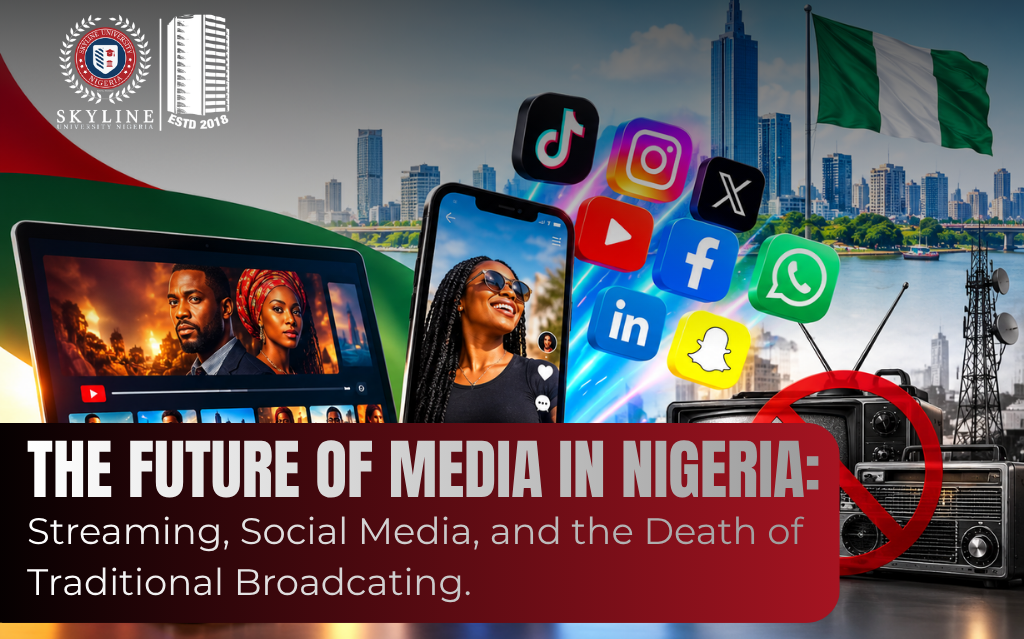
Nigeria’s media industry is undergoing a profound transformation, driven by digital technology, changing audience preferences and the growing influence of social media. Television, radio and newspapers, which once dominated information and entertainment, now compete with streaming services, online news platforms and content creators. However, the future is not necessarily the complete disappearance of traditional broadcasting. Rather, it is the emergence of a more connected, interactive and digitally driven media ecosystem.
The Rise of Streaming Platforms
Streaming has fundamentally changed how Nigerians consume entertainment. Platforms such as YouTube, Netflix and Showmax allow audiences to access films, documentaries, music and other content on demand, without depending entirely on conventional broadcasting schedules. This flexibility is particularly attractive to younger audiences who prefer personalised entertainment and mobile access.
According to PwC (2025), Nigeria’s entertainment and media industry is experiencing digital-driven growth, with over-the-top streaming services contributing to changing consumption patterns. This creates opportunities for Nigerian filmmakers, musicians and independent producers to reach wider audiences and generate revenue beyond traditional distribution channels. Nevertheless, high data costs, unreliable electricity, limited purchasing power and uneven internet access continue to restrict participation, particularly among low-income households and rural communities.
Social Media and the Democratization of Information
Social media platforms, including Facebook, Instagram, TikTok, WhatsApp and X, have transformed news distribution and public engagement. Information now travels rapidly, enabling citizens, journalists and independent creators to report events, express opinions and participate in national conversations.
DataReportal (2026) estimated that Nigeria had 109 million internet users and 47.8 million social media user identities by the end of 2025. These figures illustrate the expanding digital environment, although social media identities should not be interpreted as unique individuals. The Reuters Institute’s Digital News Report 2025 also highlights the growing importance of social platforms in news consumption, particularly Facebook, YouTube and X.
This transformation has weakened traditional media’s exclusive control over information. However, it has also intensified concerns about misinformation, manipulated content, online harassment and declining public trust. Consequently, digital media organisations must prioritise fact-checking, responsible reporting and professional ethics.
Is Traditional Broadcasting Dying?
The phrase “death of traditional broadcasting” captures the pressure facing conventional media, but it risks overstating the situation. Radio and television remain important sources of news, education and public information, particularly for communities with limited internet access. Their established infrastructure, professional journalists and public-service responsibilities continue to provide considerable value.
The real challenge is the decline of traditional broadcasting as a stand-alone model. Media organizations increasingly need to distribute content across television, radio, websites, podcasts, livestreams and social media. Broadcasters that combine professional journalism with digital accessibility can retain existing audiences while attracting younger generations.
The Road Ahead
The future of Nigerian media will depend on innovation, affordability, credibility and inclusion. Media organizations must invest in digital production, audience engagement, multimedia storytelling and sustainable revenue models. Policymakers and telecommunications providers should also address connectivity gaps and affordability while protecting freedom of expression.
Ultimately, streaming and social media are not simply replacing traditional broadcasting; they are redefining its purpose and delivery. The organizations most likely to thrive will be those that embrace technological change without abandoning accuracy, accountability and public service. Nigeria’s media future will therefore belong not exclusively to traditional broadcasters or digital platforms, but to those capable of combining the strengths of both.
References
DataReportal. (2026). Digital 2026: Nigeria. https://datareportal.com/reports/digital-2026-nigeria
PricewaterhouseCoopers (PwC). (2025). Africa Entertainment and Media Outlook 2025–2029. https://www.pwc.com/ng/en/publications/entertainment-and-media-outlook.html
Reuters Institute for the Study of Journalism. (2025). Digital News Report 2025: Nigeria. University of Oxford. https://reutersinstitute.politics.ox.ac.uk/digital-news-report/2025/nigeria
written By, Mr. Abdulsalam Mustapha.