
Abstract
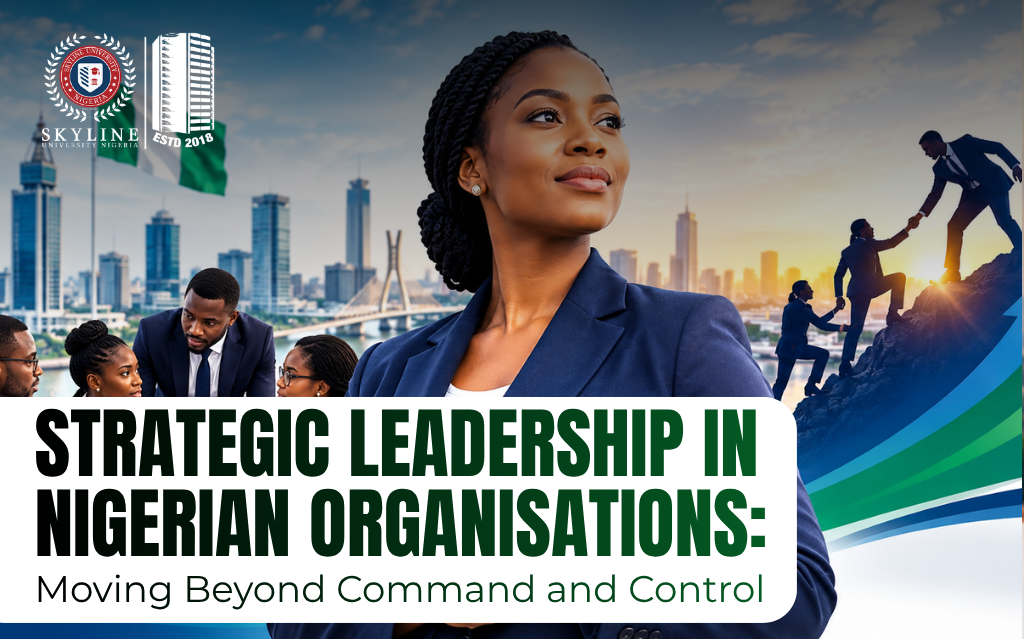
This article explores how executive leadership in Nigerian businesses has evolved from traditional, centralized “command-and-control” models to more adaptive strategic leadership approaches. Operating in an environment filled with institutional challenges and volatility, Nigerian companies often struggle under autocratic management styles. By integrating Upper Echelons Theory and Dynamic Capabilities, this paper illustrates how executive teams can balance high power-distance cultural norms with decentralized, vision-driven decision-making to foster sustainable resilience.
The Imperative for Change
For many years, the managerial frameworks in Nigerian corporate and public sectors have been heavily influenced by autocratic command-and-control systems. These systems, which stem from military-administrative legacies and are bolstered by paternalistic social structures, concentrate strategic decision-making power entirely within executive bottlenecks. However, in the current Volatile, Uncertain, Complex, and Ambiguous (VUCA) landscape of Nigeria—characterized by currency fluctuations, inflation, and shifting regulations—such rigid approaches are proving ineffective.
According to Upper Echelons Theory (Hambrick & Mason, 1984), the strategic choices and performance outcomes of a firm are closely tied to the cognitive frameworks and values of its top management. When executive teams isolate themselves behind high power-distance barriers, the organization’s ability to process information is significantly hindered. This leads to suppressed operational signals, stifled innovation, and a dangerously slow response to market changes, leaving firms vulnerable to severe environmental shocks.
The New Strategic Paradigm
To secure a sustainable competitive edge in emerging markets, Nigerian businesses need to embrace a dynamic strategic leadership paradigm that focuses on essential dimensions:
- Strategic Agility and Dynamic Capabilities: According to Teece et al. (1997), organizations need to be on their toes, constantly sensing market changes, seizing new opportunities, and reshaping their internal resources before the market shifts catch them off guard.
- Psychological Safety and Open Dialogue: It’s crucial for leaders to foster an environment where middle managers feel safe to express concerns and challenge strategic assumptions without worrying about facing backlash from higher-ups.
- Empowered, Decentralized Decision-Making: By stepping away from micromanagement, leaders can empower cross-functional teams with the authority to make decisions, allowing for quicker responses to local needs.
- Vision-Driven Engagement: Today’s strategic leaders need to share a compelling long-term vision that connects employees’ identities with the broader purpose of the organization.
Contextual Drivers and Institutional Realities
Shifting away from a command-and-control approach means finding a balance between management theory and the deeply rooted socio-cultural realities. In Nigeria, organizations often navigate institutional voids, like unpredictable regulations (Amaeshi et al., 2016). In these situations, paternalistic leadership has historically acted as an informal way to manage risks.
Moreover, the workplace culture in Nigeria is influenced by a significant power distance and respect for seniority. Effective strategic leadership doesn’t mean disregarding formal respect; instead, it involves managing the ambiguity that comes with context. Executive leaders should use their paternalistic authority to explicitly allow for autonomy, framing delegation as a sign of trust.
Managerial Implications and Conclusion
To put this strategic shift into action, leadership teams across various sectors in Nigeria should focus on these key steps:
i). Revamp Executive Incentive Structures: Shift the focus of executive evaluations to prioritize long-term capability building and talent development instead of just short-term performance metrics.
ii). Establish Upward Feedback Mechanisms: Create formal, non-punitive channels for bottom-up communication and risk reporting to help break through cultural barriers.
iii). Strengthen Middle Management Capacity: Equip middle managers with the strategic tools and decision-making authority they need to function as independent operational leaders.
In summary, moving away from a command-and-control approach is essential for the survival of firms in Nigeria. By fostering a culture of participative strategic leadership, organizations can tap into hidden human potential and develop resilient dynamic capabilities that are well-suited to the realities of emerging markets.
References
Amaeshi, K., Adegbite, E., & Rajwani, T. (2016). Corporate Social Responsibility in Challenging and Non-enabling Institutional Contexts: Do Institutional Voids matter? Journal of Business Ethics, 134(1), 135–153. https://doi.org/10.1007/s10551-014-2420-4
Hambrick, D. C., & Mason, P. A. (1984). Upper Echelons: The Organization as a Reflection of Its Top Managers. Academy of Management Review, 9(2), 193–206. https://doi.org/10.5465/amr.1984.4277628
Teece, D. J., Pisano, G., & Shuen, A. (1997). Dynamic Capabilities and Strategic Management. Strategic Management Journal, 18(7), 509–533. https://doi.org/10.1142/9789812834478_0002
Written By, Dr. Pius Egbunu Okeh