
Introduction
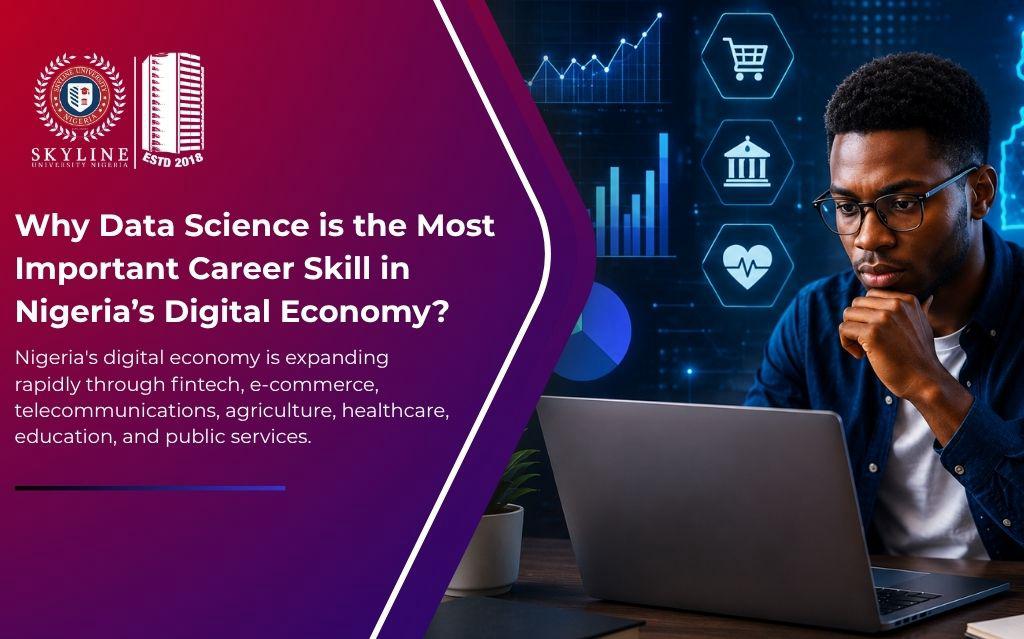
Nigeria’s digital economy is expanding rapidly through fintech, e-commerce, telecommunications, agriculture, healthcare, education, and public services. As organizations generate increasing volumes of data, the ability to collect, analyze, and interpret that data has become a strategic advantage. Data science combines statistics, programming, machine learning, and domain knowledge to transform raw data into actionable insights. Consequently, it has emerged as one of the most valuable career skills for graduates and professionals.
The Rise of Nigeria’s Digital Economy
Government digital initiatives, widespread mobile connectivity, digital payment systems, and technology startups have accelerated digital transformation. Businesses now rely on data to understand customer behavior, improve efficiency, detect fraud, forecast demand, and support decision-making. This growing dependence has created strong demand for data scientists and analysts.
Why Data Science Matters
Data science enables evidence-based decision making, improves business performance, supports artificial intelligence applications, and creates innovation across industries. Banks use predictive analytics for credit scoring and fraud detection, hospitals analyze patient data to improve outcomes, farmers apply data-driven precision agriculture, while governments use analytics for planning and policy evaluation.
Career Opportunities
Professionals with data science skills can work as Data Analysts, Data Scientists, Machine Learning Engineers, Business Intelligence Analysts, AI Engineers, Data Engineers, and Research Scientists. These opportunities exist in finance, telecommunications, health, education, manufacturing, agriculture, cybersecurity, and consulting, both within Nigeria and remotely for global employers.
Skills Required
Essential competencies include Python or R programming, SQL, statistics, probability, data visualization, machine learning, cloud computing, critical thinking, communication, and ethical handling of data. Familiarity with tools such as Pandas, NumPy, Power BI, Tableau, TensorFlow, and Scikit-learn further improves employability.
Challenges
Despite increasing opportunities, challenges remain, including limited computing infrastructure, inconsistent access to quality datasets, shortages of experienced mentors, and the need for continuous upskilling. Universities and industry should collaborate to strengthen practical training and research.
Conclusion
Data science is more than a technical discipline; it is a strategic capability that drives innovation, productivity, and economic growth. As Nigeria continues its digital transformation, individuals with strong data science skills will be well positioned to solve real-world problems, create new businesses, and contribute to national development. Investing in data science education today is therefore an investment in Nigeria’s digital future.
References
- Provost, F., & Fawcett, T. (2013). Data Science for Business.
- Davenport, T. H., & Patil, D. J. (2012). Data Scientist: The Sexiest Job of the 21st Century. Harvard Business Review.
- National Information Technology Development Agency (NITDA). Nigeria Data Protection and Digital Economy publications.
Mr. Alex Aaron, School of Science and Information Technology, Skyline University, Nigeria