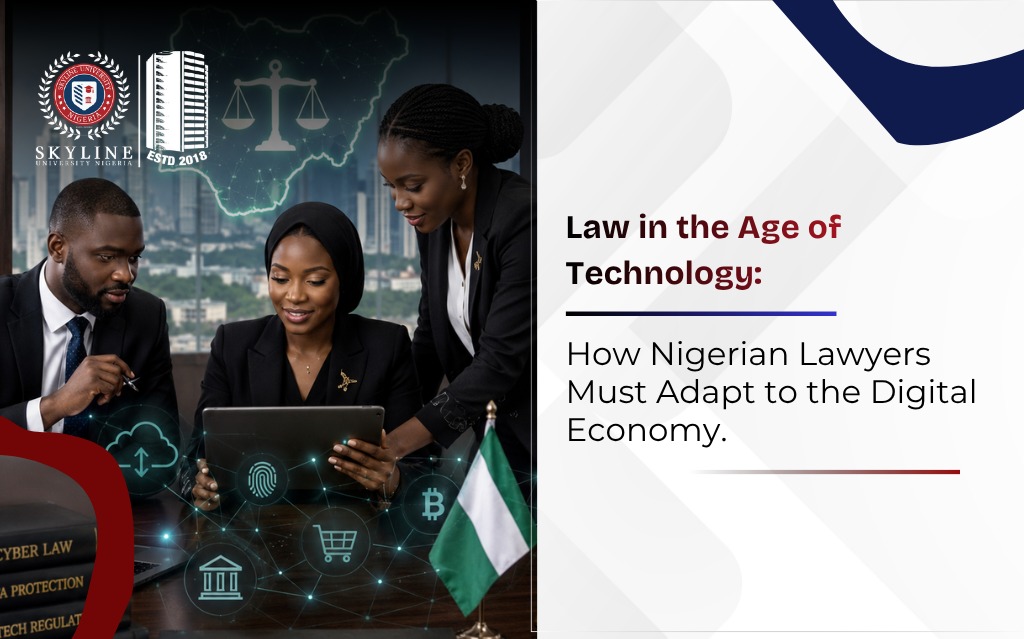
Law in the Age of Technology: How Nigerian Lawyers Must Adapt to the Digital Economy
Technology has fundamentally transformed the legal profession, reshaping how legal services are delivered, justice is administered, and legal education is conducted. This shift has quietly changed what it means to practise law in an economy that is going digital. It is important to note that beyond the traditional legal practice using Information and Communication Technology (ICT), innovations such as artificial intelligence (AI), cloud computing, digital legal databases, blockchain, virtual court hearings, and legal information analytics are redefining legal practice globally. In Nigeria, technology has improved legal research, legal document automation, case management, and access to justice, compelling legal practitioners to acquire digital competencies while maintaining the ethical standards that underpin the profession. You can be brilliant at contract law, litigation strategy, and courtroom advocacy, yet have little useful advice to offer a fintech client on data localisation or a start-up founder questioning whether a smart contract is legally enforceable. Knowing the law is no longer enough. For Nigerian lawyers, keeping pace with the digital legal ecosystem is not about appearing technologically savvy, it is about remaining valuable to the clients the profession exists to serve. Technology and the Changing Legal Profession Technology today has significantly enhanced efficiency across law firms, courts, government agencies, universities, and corporate organisations. Unlike the era of manual legal research, where lawyers spent days consulting physical law reports to prepare legal opinions or court processes, digital platforms such as the Nigerian Weekly Law Reports, LawPavilion, LegalPedia, LexisNexis, and other electronic law reports now enable practitioners to retrieve legal authorities within seconds. Another major innovation that technology brought is AI-powered applications which ethically assist with legal research, contract review, document drafting, due diligence, compliance monitoring, predictive analytics, and client engagement through legal chatbots. However, maximising the benefits of these technologies requires proper training and continuous professional development. These generative AI includes ChatGPT, Claude, Gemini, Copilot among others. Furthermore, technology has also created new areas of legal practice, including data protection, cybersecurity, fintech regulation, digital taxation, blockchain, and AI governance. As these fields continue to evolve, lawyers must be equipped to understand their legal implications and provide practical, technology-informed advice rather than purely theoretical solutions. As a result of the expanded technology innovation, it is very important that lawyers must be well equipped to navigate the legal implications of these developments and offer practical, technology-informed solutions rather than purely theoretical advice. This technological shift carries a productivity dimension that all lawyers cannot afford to ignore. Today, the digital research platforms, AI-assisted legal drafting, e-filing, virtual court hearings, and case management systems reduce the time spent on routine tasks, enabling lawyers to focus on legal analysis, strategy, negotiation, and client advisory. Technology therefore enhances, rather than replaces, professional judgment. How Nigerian Lawyers Must Adapt to the Digital Economy The changing legal landscape demands a deliberate shift in mindset. For Nigerian lawyers, adaptation is no longer optional; it is a professional imperative. Beyond mastering substantive law, lawyers must cultivate competence in legal technology, digital regulation, cybersecurity, electronic evidence, data protection, and AI-assisted legal research if they are to provide effective legal services in an increasingly digital economy. However, technical competence must be complemented by critical thinking, commercial awareness, and a sound understanding of emerging regulatory frameworks, as technology is only as effective as the professional judgment guiding its use. Legal education, being the foundation upon which lawyers are trained, makes it imperative for legal institutions including universities, the Nigerian Law School, the Council of Legal Education, the Nigerian Bar Association, and individual law firms to play a crucial role in strengthening legal technology education and continuing legal education programmes to prepare lawyers for emerging areas of practice. While AI and other digital tools can significantly improve efficiency and productivity, lawyers must continue to exercise independent professional judgment, safeguard client confidentiality, verify AI-generated outputs before relying on them, and uphold the ethical standards that define the legal profession. A lawyer who cannot competently advise on data privacy, data protection, or cybersecurity risks will struggle to meet the expectations of today’s clients, just as a law firm that relies entirely on paper files and manual research will inevitably fall behind more technologically equipped competitors. Conclusion The future of legal practice in Nigeria lies in the responsible integration of technology with legal expertise. The digital economy is redefining both legal practice and the competencies required of the modern lawyer. Adapting does not mean abandoning the fundamentals; ethical responsibility, sound legal reasoning, and professional judgment remain the bedrock of the profession. What has changed is the toolkit. Lawyers who embrace technological innovation while preserving these core values, and who commit themselves to lifelong learning, will be best positioned to thrive. Ultimately, the future of the legal profession belongs not to technology itself but to lawyers who can responsibly harness innovation to deliver accessible, efficient, and client-centred legal services. In the age of technology, adaptation is no longer merely an advantage, it is a professional necessity. References Constitution of the Federal Republic of Nigeria, 1999 (as amended in 2023). Cybercrimes (Prohibition, Prevention, etc.) Act, 2015 (as amended). Evidence Act, 2011 (as amended in 2023) Nigeria Data Protection Act, 2023. Rules of Professional Conduct for Legal Practitioners, 2023. Akanle, O.O., ‘The Role of Artificial Intelligence in Enhancing Legal Services Delivery in Nigeria: Challenges, Opportunities, and Future Prospects’ [2025] Crescent University Law Journal, (10) Nwaeze, G., ‘The Future of Law Practice in Nigeria in the Face of Global Trends and Development in Information and Communication Technology’ (2020). Okeke, U.D., Obianyo, C.I. and Ater, S.V., ‘Lawyering in the Age of Artificial Intelligence (AI): A Competency Toolkit for the Nigerian Lawyer’ [2025] Uniniger Law Journal, (1)(1) Olubiyi, I.A., Olaniyan, A.J. and Odiaka, N,, ‘The Role of Technology in the Advancement of Legal Education and Practice in Nigeria’ [2015]. Nwala, K.T., and Nwagba, O.M., ‘The Law in the Digital Age of AI and Digital Transformation Opportunities, Challenges and Future of Justice’ [2026] International Journal of Research and Innovation in Social Science (IJRISS), (10) (5) WRITTEN BY: Aishat Wuraola Popoola
Law in the Age of Technology: How Nigerian Lawyers Must Adapt to the Digital Economy Read More »